Of all of the criticisms leveled at Christopher Nolan’s “The Odyssey” (other than the one I’ve: that your complete film is a frigging mess), essentially the most resonant, to me, was the grievance that Nolan had made a mistake by leaving the Greek gods out of the story. He actually demonstrated that you may make a model of Homer minus the gods; he didn’t essentially present that it could possibly be executed with out shedding a vital dimension. Apart from, if you happen to can’t see gods at a film of “The Odyssey,” the place are you going to see them?
The reply is: at a Japanese monster film — extra thrilling, by leagues, than “The Odyssey” — the place the monsters possess an ominous majesty that’s not of this world, whilst they’re in the midst of laying waste to it.
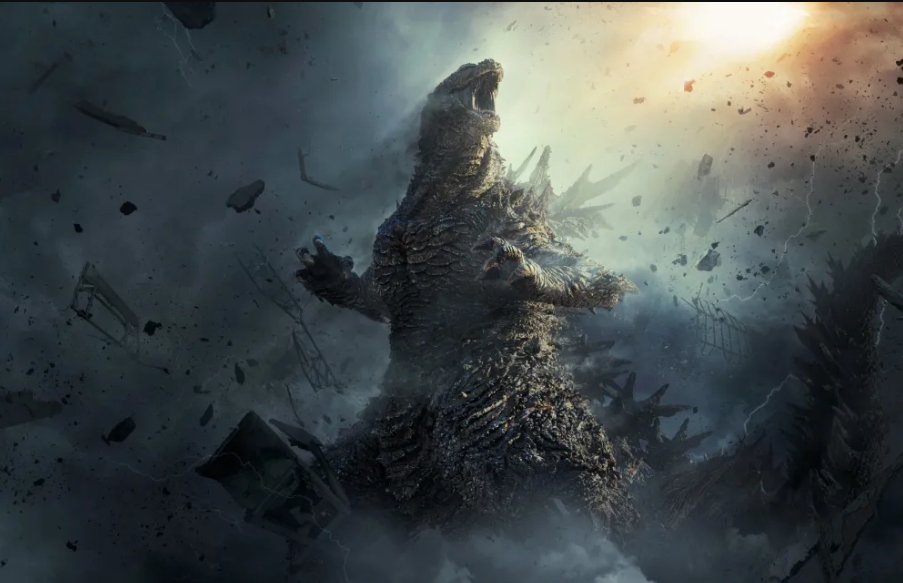
In “Godzilla Minus Zero,” which premiered tonight on the New York Movie Pageant (it opens Nov. 6), there are two oversize mystic beasts: Godzilla, the unique kaiju (the character is now 72 years outdated, proving that 72 is the brand new superior), and King Ghidorah, the dragon hydra who made his first look within the 1964 kaiju basic “Ghidorah, the Three-Headed Monster.” Every is a formidable creature, although in each instances it’s greater than a matter of epic stomp or gargantuan wing energy. When Godzilla tilts his head as much as the sky, gathers his may, after which shoots out a blast of radioactivity that may stage a metropolis, it’s an exhibition of transcendent drive. And Ghidorah’s heads — which look, up shut, like costume figures out of a Golden Dragon Dance — emit orange lightning volts that reach for half a mile. These aren’t mere monsters. They’re critical film gods.
“Godzilla Minus Zero” is ready in 1949, and it opens with a startling sequence wherein Ghidorah, with just one head (this may change), exhibits up within the metropolis of Matsumoto and destroys it. We’re given a grand vista of demolition, and likewise close-ups of Ghidorah seen from the point-of-view of Professor Murakami (Min Tanaka), a Hiroshima survivor who’s been doing organic creature analysis. Godzilla will quickly flip up as nicely, though he was thought to have been destroyed on the finish of “Godzilla Minus One.” (It’s exhausting to destroy a god.) To avoid wasting Japan, Kenji Noda (Hidetake Yoshioka), the high-strung, pencil-necked, Einstein-haired director of the Massive-Scale Catastrophe Response Bureau, leads his workforce in devising a plan that’s acquired a sandbox-showdown ingenuity: They may lure each creatures to a single locale and goad them into combating one another. Whichever one stays standing shall be wounded and weakened, and the human forces can then end that monster off.
While you go to see a giant visual-effects film, like one thing from Marvel, the closing credit that roll on for 12 minutes will characteristic a number of armies of visual-effects groups (every digital firm with its personal normal). I’ve little doubt {that a} formidable military labored on “Godzilla Minus Zero.” However it’s additionally a film that options the extremely uncommon credit score “VFX, written, and directed by Takashi Yamazaki.” That’s an indication of how a lot the film’s visible results emanate instantly from the creativeness of the filmmaker. He’s writing, he’s directing, and he’s orchestrating spectacular gargantuan motion work of beasts in movement. He’s an artist of larger-than-life pop horror.
We’ve seen numerous monster duels in kaiju motion pictures (outdated and new, good and dangerous, Japanese and American), however Yamazaki, who rebooted the style and took it to a brand new peak within the revelatory 2023 retro kaiju basic “Godzilla Minus One,” works with a high quality that not one of the filmmakers of latest many years has summoned: a fairy-tale innocence, an immersion within the annihilating heavy-metal poetry of Godzilla — the best way the destruction of a metropolis can turn into a spectacle out of a dream (which is to say, a nationwide nightmare). In “Godzilla Minus Zero,” when Godzilla and King Ghidorah go at it, it’s greater than a WWE match of primeval rivals. It’s a conflict of the titans that can scale back everybody within the viewers to a wide-eyed, jaw-dropped youngster.
“Godzilla Minus One” was justly celebrated for its human story, which felt like one thing out of a Kurosawa film of the ’50s. In “Godzilla Minus Zero,” Yamazaki follows by on that, persevering with the story of Kōichi Shikishima (Ryunosuke Kamiki), the previous World Battle II kamikaze pilot; Noriko (Minamo Hamabe), who’s now his spouse; and Akiko (Sae Nagatani), their adopted daughter, who has grown right into a verbally precocious seven-year-old. The destiny of this household is on the coronary heart of the movie’s emotional palette. To battle the creatures, Kōichi will return into fighter-pilot mode, however the companies of Noriko shall be known as on as nicely. She’s one of many survivors of Godzilla’s 1947 assault who now has bits of Godzilla DNA embedded in her physique (which is why she wears an eyepatch).
For a very long time, kaiju motion pictures had been a semi-joke — a fusion of the colossal and the tacky, and the truth that you couldn’t separate the 2 was a part of what gave the style its distinctive shlock magic. However Yamazaki transcends all that. His staging attracts on our collective nostalgic reminiscence of kaiju grandeur, and it additionally dignifies the style by constructing it on a drama that’s staged with ardour and vigor. When did anybody ever speak about performances in a Godzilla film? However in “Godzilla Minus Zero,” one responds to the excessive nervousness of Yoshioka’s Noda, and to the magnetic intelligence of Masami Nagasawa as Makoto Aoyama, a meteorologist whose instinct about storms has a touch of the prophetic. Min Tanaka, who performs the professor, is an actor who was born on March 10, 1945, the day of the firebombing of Tokyo (the deadliest air raid in human historical past), and his courtly however simmering presence powerfully channels the movie’s consciousness of historical past. Yamazaki phases a few audacious sequences that really feel, of their method, like his reply to “Oppenheimer.” One is a fantasy of Godzilla approaching Manhattan the best way he as soon as approached Tokyo, a chilling imaginative and prescient for any American to behold.
At first, when the Japanese officers assume that they’re contending solely with Ghidorah, the movie’s battles have a tactical stateliness. Ghidorah heads off to the mountains and hibernates, curling up like an enormous snake, which makes them assume they’ll bomb him into oblivion, utilizing planes and weapons borrowed from the U.S. However all that accomplishes is to wake the sleeping large. The sequence wherein a half dozen planes battle Ghidorah within the air is grand, eye-popping filmmaking. And that’s simply the appetizer, as Godzilla’s return heralds a battle of staggering vastness.
Within the ultimate part, a plot strand or two will get a bit tangled. The professor has a hidden agenda, and the way he ever meant to hold it out stays too summary to be solely clear. But as key characters are put below fireplace, we understand how a lot we’ve come to care about these creature battlers. They’re rooted in a time and place that feels all too actual, and this permits the monsters to parade their primitive may in a method meaning one thing. It was a stroke of inspiration on Yamazaki’s half to reset the kaiju style within the late ’40s, throughout the Atomic Age the place it’s spiritually rooted (the unique “Gojira” was launched in 1954). The creators of the brand new James Bond sequence would do nicely to comply with go well with. (That’s how Bond could possibly be very important once more.) “Godzilla Minus Zero” is destined to attach with an enormous worldwide viewers, and it’s already clear that this gained’t be the final of Yamazaki’s kaiju epics. That’s as a result of the film proves that whenever you do it proper, what appeared outdated can turn into timeless.